Log in / Sign in
Volvo Construction Equipment DPF Problems: Common Causes and Modern Solutions for Heavy Equipment
What Causes DPF Problems on Volvo Construction Equipment?
On Volvo Construction Equipment (Volvo CE) machines, issues with the Diesel Particulate Filter (DPF) are largely a consequence of the conditions under which they are used. When these machines are idled for long periods of time, and the engine undergoes frequent load changes, short operating cycles, and low exhaust gas temperatures, the DPF is unable to fully regenerate. Subsequently, the DPF is susceptible to frequent regeneration, system faults, and a loss of engine power, which puts the machine into Derate Mode, and leads to higher costs of operation.
Construction equipment operates in many harsh environments. The downtime of a single machine can delay an entire project and cost thousands of dollars. That’s why engine reliability and emissions control systems are critical for owners and fleet managers operating Volvo Construction Equipment. On machines with high engine hours, the DPF, EGR, and SCR systems are common sources of unplanned downtime.
In this article, we’ll take a closer look at the Volvo Construction Equipment lineup, discuss the most common DPF-related issues affecting these machines, explain why these problems occur, and review the solutions commonly used by construction equipment owners today.
What Is Volvo Construction Equipment?
Volvo Construction Equipment (Volvo CE) is the largest business division of the Volvo Group. They design and manufacture equipment used in construction, quarries, and heavy industry. Construction equipment made by Volvo is used all over the world. These machines are applied in road construction, mining and quarry operations, as well as in services and projects of industrial, municipal, and forestry applications. They are also used in large infrastructure projects.
Products in the Volvo CE lineup Include:
- Wheeled and crawler excavators
- Wheel loaders
- Articulated dump trucks (ADTs)
- Soil compactors and rollers
- Asphalt pavers
- Motor graders
- Mini excavators
- Compact loaders
- Wheeled excavators
- Specialized equipment for quarrying and heavy construction applications
Most modern Volvo CE models are powered by Volvo D5, D8, D11, D13, and D16 diesel engines that comply with Tier 4 Final (USA) and Stage V (Europe) emissions standards. To meet these regulations, the engines rely on advanced emissions control technologies, including:
- Diesel Particulate Filter (DPF)
- Selective Catalytic Reduction (SCR) with DEF/AdBlue
- Exhaust Gas Recirculation (EGR)
- Exhaust temperature sensors
- Pressure sensors
- NOx sensors
The Most Common Volvo CE Problems
Although Volvo Construction Equipment is well known for its durability and reliability, modern emissions control systems have become one of the most expensive areas of maintenance over the life of the machine.
Examples of some common issues include:
- Frequent DPF regenerations
- Clogged Diesel Particulate Filters
- EGR valve failures
- SCR/DEF system faults
- Pressure, temperature, and NOx sensor failures
- Engine power loss
- Derate Mode
- Increased fuel consumption
- High exhaust backpressure
- Premature turbocharger wear
This challenge can affect virtually every model of Volvo Construction Equipment. However, there are specific models that are more impacted. An example of these models includes motor graders, wheel loaders, excavators, and articulated dump trucks that operate for long hours that experience frequent changes in engine load.
Volvo Grader DPF Issues: Why Are Motor Graders More Prone to DPF Problems?
A motor grader operates very differently from an over-the-road truck.
During road grading operations, the machine typically:
- Runs at low engine RPM for extended periods
- Constantly operates under changing engine loads
- Spends long hours idling
- Rarely maintains a consistent heavy load for an extended period
Unfortunately, these are exactly the operating conditions that are least favorable for proper DPF performance.
Did You Know?
Most premature DPF failures on construction equipment are not the result of defects in the filter, much like many DPF filter failures in the field, most failures are attributed to the operating conditions. Extended idle, low-RPM driving, and interrupted regeneration cycles adversely affect the aftertreatment system as a whole.
The Diesel Particulate Filter is designed to capture soot particles and burn them off during the regeneration process. If the temperatures of exhaust gases do not reach the required levels, regeneration will never complete successfully.
As a result, operators may see:
- Common requests for regeneration
- DPF diagnostic trouble codes
- Exhaust backpressure issues
- Loss of engine power
- Derate Mode activation
- Increased fuel costs
For contractors and fleet managers, the above scenarios usually represent a higher overall cost of maintenance, a decrease in productivity, and a higher cost of equipment and resource downtimes.
What Causes DPF Issues on Volvo Construction Equipment?
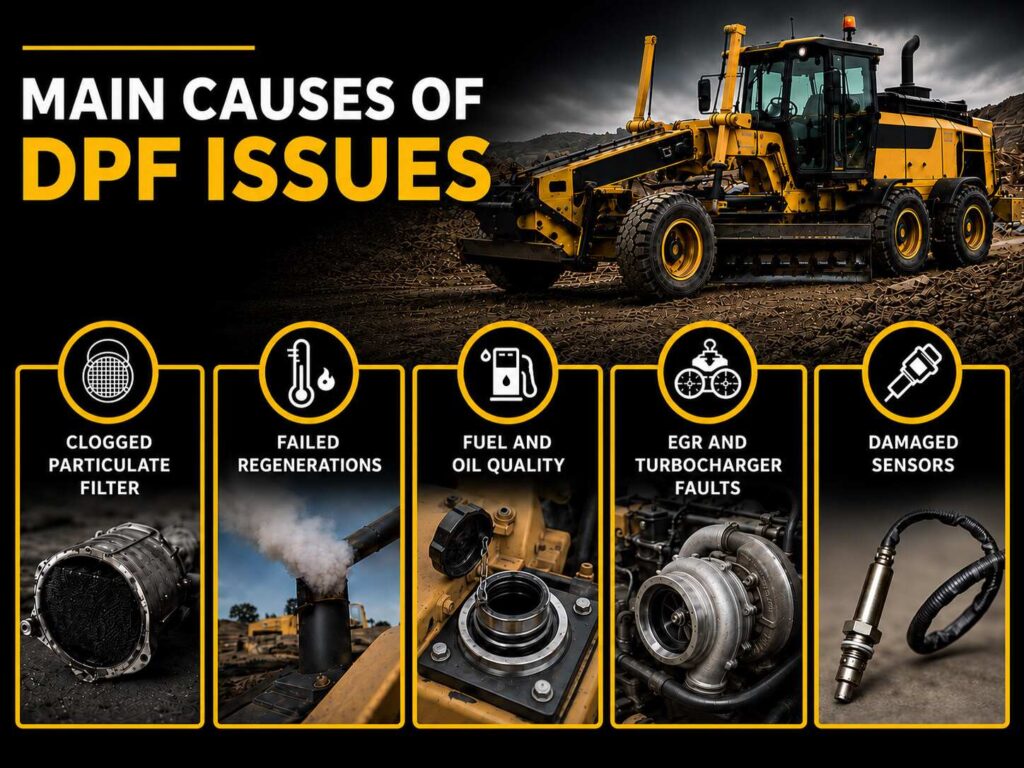
Clogged Diesel Particulate Filter
Every diesel engine produces soot, which is captured by the Diesel Particulate Filter.
On motor graders and other construction equipment, soot often accumulates much faster than the manufacturer’s regeneration strategy was designed to handle. As the soot load in the filter approaches capacity, the engine control unit responds by increasing the frequency of regeneration. If unsuccessful, the machine will enter Derate Mode. This will protect the engine and emissions system.
Incomplete DPF Regeneration
Reliable regen cycles usually require an exhaust gas temperature of about 1,110 °F (600 °C) and consistent operation of the engine under a steady load.
In the practical case of construction scenarios, it is rare for conditions to last long enough to achieve complete regeneration and remove the accumulated soot with pyrolysis.
Poor Fuel and Engine Oil Quality
Lower-quality diesel fuel leads to increased soot emissions and causes DPF to fill up more quickly.
Using engine oil that is not up to the manufacturer’s standards can also speed up the accumulation of ash in the filter. Ash typically cannot be removed in the process of regeneration like soot, and will progressively shorten the service life of the DPF.
EGR Valve and Turbocharger Problems
A contaminated or malfunctioning EGR valve reduces combustion efficiency and increases soot production.
An increase in soot levels creates a cascade of system performance issues by increased stress on the turbocharger and Diesel Particulate Filter.
Faulty Sensors
In many cases, DPF-related fault codes are caused not by the filter itself, but by failed sensors or emissions system components, including:
- Differential pressure sensors
- Exhaust temperature sensors
- NOx sensors
- SCR system components
Even a perfectly functional DPF may repeatedly request regeneration if inaccurate sensor readings cause the engine control module to misinterpret operating conditions.
Standard Repair Methods
Volvo typically recommends several approaches for restoring the emissions system, including:
- Forced DPF regeneration
- Professional DPF cleaning
- Diesel Particulate Filter replacement
- Repair of SCR and EGR system components
These methods can often restore normal operation. However, the improvement may only be temporary. DPF problems often reoccur after a certain amount of time if the equipment continues to be used in the same challenging operating conditions.
In addition, replacing a DPF, NOx sensors, SCR components, and other aftertreatment parts can become a significant expense—particularly on high-hour construction equipment.
Software Optimization and Engine Tuning
For machines that operate exclusively off-highway and spend their lives in demanding working environments, many owners choose professional ECU software optimization to improve engine performance and reliability.
Depending on the application, software programming may include:
- ECU mapping optimization
- Fuel map optimization
- Torque programming
- Elimination of unnecessary regeneration cycles
- Software solutions for DPF systems
- EGR software solutions
- SCR/DEF software solutions
- Engine response optimization for real-world working conditions
When performed by experienced engineers, professional ECU tuning can improve engine consistency, reduce unplanned downtime, and lower long-term operating costs.
These modifications should be done by people who have plenty of experience with construction equipment. Every Volvo CE platform has different engine management strategies, and ECU software.
Why Volvo Equipment Owners Choose DrunkLab
When it comes to ECU diagnostics and software programming for Volvo Construction Equipment, experience is just as important as the services offered.
For more than 15 years, DrunkLab has specialized in software development, ECU reverse engineering, and remote programming solutions for Volvo Group vehicles and equipment. The company supports multiple Volvo CE platforms and provides engineering services for both individual equipment owners and large construction and service organizations.
DrunkLab provides the following services for Volvo CE:
- ECU diagnostics
- Remote ECU programming
- Factory tuning optimization
- Power and torque tuning
- DPF software solutions
- EGR software solutions
- SCR/DEF software tuning
- Factory software restoration (Stock Restore)
- Remote technical support and engineering assistance
With extensive experience working with Volvo Group electronic control systems, DrunkLab engineers understand the differences between multiple ECU generations and engine management strategies, allowing them to recommend solutions tailored to each machine and its specific operating conditions.
Conclusion
Worldwide, we know Volvo Construction Equipment to be durable, reliable, and productive. However, as machines age, complex repair and unplanned downtime costs tend to significantly increase due to emissions control systems. This is especially true for motor graders, excavators, wheel loaders and machines that spend a long time idling or running under fluctuating engine load.
Routine diagnostics, proper maintenance, and professional ECU software optimization can significantly improve equipment reliability, reduce operating expenses, and minimize the risk of unexpected shutdowns.
Whether you need ECU diagnostics, factory software restoration, professional ECU programming or software solutions for DPF, EGR, and SCR systems, DrunkLab brings more than 15 years of engineering experience, proprietary software development, and remote support for Volvo CE customers around the world.
FAQ
What causes frequent DPF regenerations on Volvo Construction Equipment?
Extended idling, low exhaust gas temperatures, inconsistent engine loads, a bad EGR valve, faulty sensors, and ash buildup in the DPF cause the DPF to regenerate too often. These will cause the DPF to fail to regenerate and will cause soot to build up excessively.
Why does Volvo Construction Equipment enter Derate Mode?
Derate Mode is activated if the Engine Control Module (ECM) identifies serious failures in the emissions control system. This is commonly caused by DPF blockages, failures within the SCR/EGR systems, malfunctioning NOx sensors, or high levels of exhaust backpressure. Minimizing engine power is a protective measure for the engine and the emissions subsystem against the escalation of damage.
Can a DPF be restored without replacing it?
Yes. If a Diesel Particulate Filter does not have mechanical damage, a restoration may be possible in many situations. Professional diagnostics, cleaning of the DPF, forced regeneration of the filter, or repairing damaged EGR components or replacing faulty sensors may fix the system without the need for installing a new filter.
Which Volvo Construction Equipment models are most likely to experience DPF problems?
Motor graders, excavators, wheel loaders, and articulated dump trucks (ADTs) that operate under variable engine loads and spend long periods idling, commonly experience DPF-related issues. These operating conditions make it difficult for the DPF to complete successful regeneration cycles.
Why does an EGR problem affect the DPF?
If the EGR valve becomes faulty or contaminated, it will result in an increase in soot during combustion. This excess soot will fill the DPF rapidly and will increase the number of regeneration cycles and will stress the entire emissions aftertreatment system as well as the turbocharger.
What does Volvo CE ECU software optimization include?
Optimization of ECU software depends on the machine and the application could involve ECU diagnostics, engine tuning adjustments, fine-tuning fuel maps, torque programming, DPF, EGR, SCR and DEF software systems, and enhancements of engine performance and reliability.
When should you schedule professional Volvo CE diagnostics?
Professional diagnostics should be performed as soon as you notice frequent DPF regenerations, engine power loss, increased fuel consumption, DPF or SCR fault codes, or the machine entering Derate Mode. Early problem detection can reduce expensive repairs and equipment downtimes, and lengthen the service life of important engine components and emission systems.
By Larry Perkinson
Diesel Expert
Last updated: July 31, 2026