Log in / Sign in
DD15 DEF and DPF Problems: Checks, Repairs, and Tuning
Truck owners look to alternative solutions when problems arise with emissions systems on commercial vehicles like DEF (SCR), DPF, and EGR systems. As mileage increases, problems with these systems can lead to warning messages, regeneration failures, reduced performance, engine derate, and unexpected downtime.
For many commercial vehicle owners with a DD15 engine, the cause may not be a single faulty component. Finding the source of the problem may require checking several components of the aftertreatment system, which can become quite expensive.
If you are dealing with recurring aftertreatment issues on a DD15, there are several basic things you can check yourself before contacting DrunkLab.
Where to Start With Basic Troubleshooting?
Check the SCR System for Obvious Issues
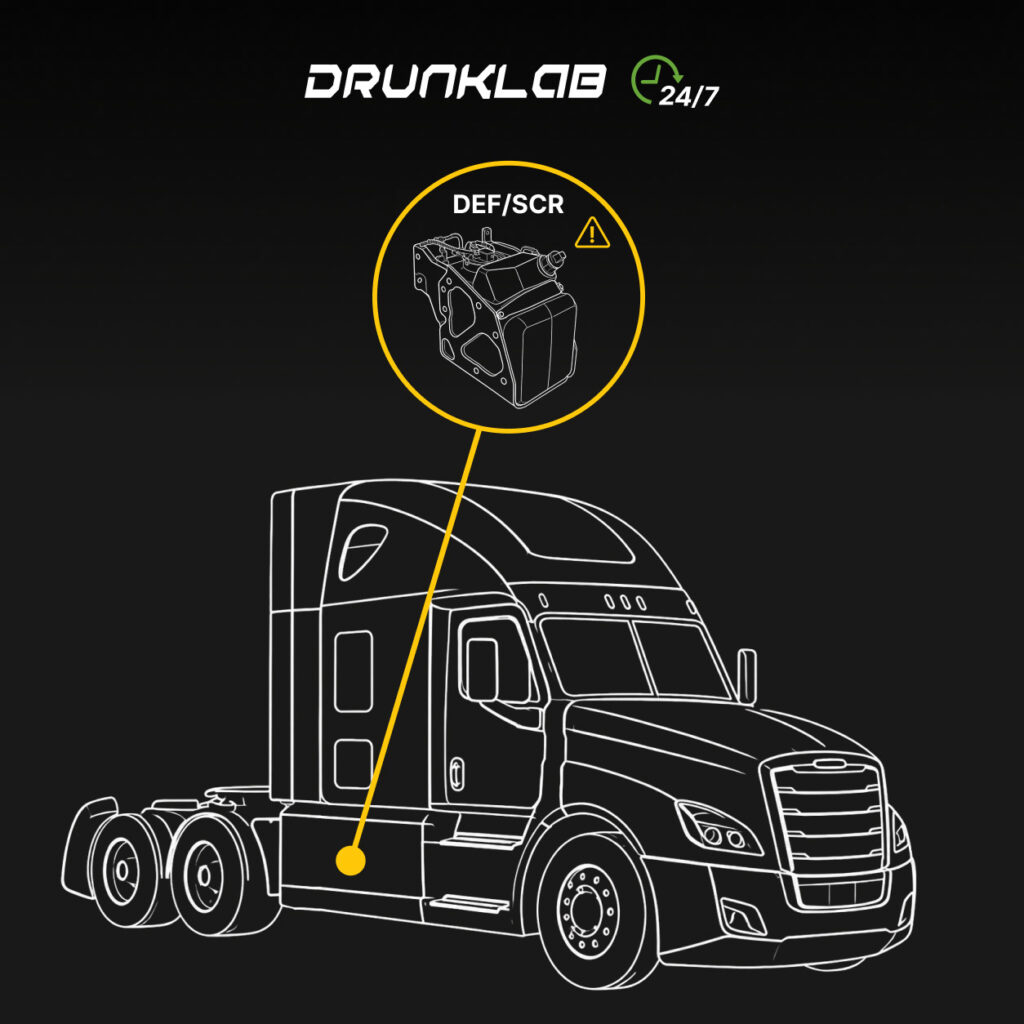
Check for the following if the truck has been reporting SCR-related faults:
- damaged wiring or connectors
- damaged DEF lines
- crystallized DEF around connections
- physical damage around the DEF pump, including corrosion or damaged connections
Check the Condition of the DPF

If the truck is experiencing frequent regeneration problems or DPF-related warnings, start by having the filter diagnosed and checking its condition. If known, the filter’s cleaning or replacement history may also be useful.
A DPF issue can sometimes be caused by another underlying problem rather than the filter itself. Replacing the filter without understanding the cause can therefore increase repair costs without resolving the underlying issue.
Check the Truck’s Service History
Factors such as mileage, aftertreatment repairs, DPF cleaning, SCR (DEF) system repairs and/or replacements, sensor replacements, and dealer software updates, are all important when reviewing the service history of a truck.
Check Warning Messages and Fault Codes
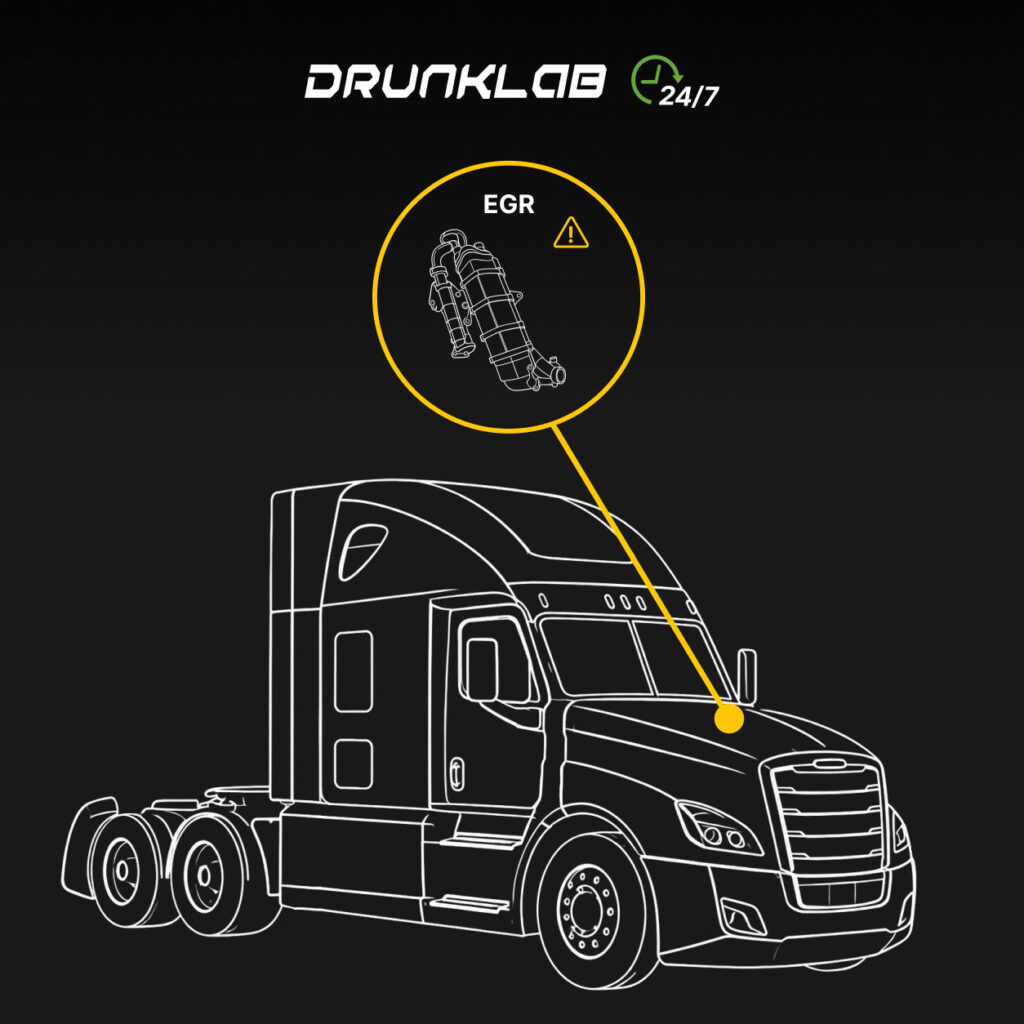
Use a diagnostic adapter and software to read the fault codes and identify which systems they relate to. This can help determine whether the issue involves the DPF, DEF/SCR, EGR, sensors, or another part of the truck.
Fault codes represent information and they do not guarantee replacement of the associated part.
Why DD15 Aftertreatment Problems Can Become Expensive
The main challenge with aftertreatment issues is that multiple components work together. A warning may lead to one component being checked while the actual problem is related to another part of the system. In some cases, additional testing is required before the owner can determine what has actually failed.
As a result, what initially looks like a relatively simple warning can lead to:
- replacement of expensive components
- DPF cleaning or replacement
- DEF system repairs
- sensor replacement
- repeated regeneration attempts
- lost working time
- truck downtime
For an owner-operator or fleet, the downtime itself can become a significant part of the overall cost.
An Alternative: Addressing Aftertreatment Issues With ECU Tuning
For owners who do not want to continue dealing with ongoing aftertreatment maintenance, ECU tuning can be an alternative option.
Instead of continuously repairing and monitoring the DPF, DEF/SCR, and EGR systems, the corresponding control functions can be disabled in the engine software.
DrunkLab specializes in remote ECU tuning for Detroit Diesel engines. All services are performed remotely through TeamViewer and are designed to disable the corresponding aftertreatment functions in the ECU. There is no need to bring the truck to a shop.
Emissions system issues do not prevent ECU tuning. However, it is important to understand that tuning will not resolve other mechanical issues with the engine or the truck’s major systems, including the fuel, cooling, electrical, and transmission systems, and these issues must be addressed beforehand. DrunkLab provides ECU tuning services, not mechanical truck repair or general diagnostics.
Real-World Example: DEF Issues on a Freightliner Cascadia With a Detroit DD15
Situations like this are common among owners of Freightliner Cascadia trucks equipped with Detroit DD15 engines.
In one real-world case involving a 2021 Freightliner Cascadia with a DD15 engine, the owner experienced very low DEF consumption and recurring faults related to low DEF system pressure. The problem returned every few hundred miles.
The owner checked several system components himself. Water was found around the DEF dosing valve connector. After cleaning and drying the connector, DEF pressure was around 142 psi at approximately 1,200 RPM, but the problem did not completely disappear. A check of the DEF delivery quantity also showed that the dosing system was supplying the required amount of fluid. In other words, even after several checks showed normal results, the system continued to operate inconsistently.
This case, in which we ultimately disabled the DEF system, shows that passing an individual test or having one component operate normally does not necessarily mean the entire system will perform properly under real-world operating conditions.
For owners who do not want to continue spending time and money on recurring aftertreatment issues, ECU tuning can be a cost-effective option where such modifications are permitted by law.
Detroit DD15 Tuning Services From DrunkLab
DrunkLab currently offers several Detroit Diesel tuning solutions that may apply to DD15-equipped trucks depending on the engine year and configuration.
Remote ECU programming for supported DD13, DD15, and DD16 engines from the 2007–2015 generation.
For trucks with automatic transmissions, only DPF/SCR delete is available. EGR delete is not recommended due to potential shifting issues. If EGR delete is requested, it is provided without warranty.
For supported 2016–2021 Detroit Diesel engines, DrunkLab offers remote ECU tuning to disable the DPF/SCR/EGR systems.
Complete DPF/EGR/SCR delete is available for trucks with manual transmissions. For automatic transmissions, DPF/SCR delete is available, but EGR must remain operational to ensure proper gear shifting. EGR delete for automatic transmissions is available only upon customer request and is provided without warranty.
Conclusion
Recurring DD15 aftertreatment problems can turn into a long cycle of diagnostics, component replacement, regeneration attempts, and downtime.
If you want to keep the factory aftertreatment system, the proper approach is to diagnose and fix the underlying issue.
If aftertreatment maintenance has become a constant source of expense and the vehicle is operated in a jurisdiction where such a modification is legally permitted, ECU tuning from DrunkLab can be an effective solution.
FAQ
Can DrunkLab diagnose an aftertreatment problem on my Detroit DD15?
No. DrunkLab specializes in ECU tuning, not general truck diagnostics or mechanical repair.
Could a DPF or DEF issue on a DD15 be caused by something else?
Yes. A fault message does not always point directly to a failed component and may be related to other parts of the emissions system. If you plan to keep the factory system, a full diagnostic inspection may be required.
Can ECU tuning repair a faulty DEF pump or DPF?
No. ECU tuning does not repair physically damaged components.
Will tuning eliminate derate issues caused by the aftertreatment system?
Yes. The appropriate tuning disables the aftertreatment control functions that can trigger derate and prevents the engine from entering this mode.
Can DrunkLab perform DD15 tuning remotely?
Yes. Detroit Diesel tuning is performed remotely through TeamViewer via the customer’s laptop and a properly working diagnostic adapter.
What DD15 model years are supported?
DrunkLab offers the Detroit Diesel tuning services for the 2007–2015, 2016–2021, and 2021–2026 generations. The specific service depends on the engine and truck configuration.
By The DrunkLab Team
Last updated: October 6, 2026