Volvo Trucks
DrunkLab Volvo Trucks Tuning Solutions
Professional ECU Programming for Volvo D11, D12, D13, D16 Engines
Volvo trucks are carefully designed for longevity, strength, and for reliability on long-distance routes. In practical use though, the OEM integrated emission systems frequently become the weakest link — particularly under high load, prolonged idling, cold weather, and high severity road conditions.
Common Issues in Real-World Volvo Truck Operation
Constant active and parked regenerations
The DPF is unable to burn off soot because of inefficient soot burning and real driving conditions, therefore frequent regeneration cycles occur. This leads to repeated active and parked regenerations, increased fuel consumption, excessive exhaust temperatures, and accelerated wear of the exhaust system components.
High soot load and DEF / SCR faults
Excessive soot buildup is typically due to EGR operation, short journeys, or extended idling. While SCR/DEF systems can be effective, they are easily triggered by inaccurate readings, fluid quality, and other factors that could potentially lead to fault codes and ultimately, derate conditions.
Power derate and limp mode activation
The system must protect itself, so when emissions thresholds are broken, the ECU will automatically reduce the amount of engine power available. These derate and limp mode events can occur without warning, significantly impacting drivability, productivity, and delivery schedules.
Sensor and module failures
Modern Volvo vehicles include several types of control modules, as well as temperature, pressure, and NOx sensors. Exposure to heat, soot, and vibration often leads to sensor drift or failure, resulting in false readings, fault codes, and unnecessary repairs.
Rising maintenance and downtime costs
Made repairs and replacement of parts, more frequent, as well as forced regenerations increases the operating costs in the long-term. Unplanned downtime influences Maintenance budgets, reduces Vehicle availability, and ultimately decreases Fleet profitability.
DrunkLab focuses on tuning ECU for Volvo trucks, remote software programming for eco system deletes, and assisting operators in restoring engine efficiency, lessening operational costs, and prolonging engine life.
If you are searching for Volvo DPF/EGR/SCR/DEF delete, Volvo DPF/SCR-off emulator solutions, remote Volvo tuning without Tech Tool, or professional Volvo truck diagnostic software, DrunkLab delivers proven, field-tested results worldwide.
Supported Volvo Engines & ECU Platforms
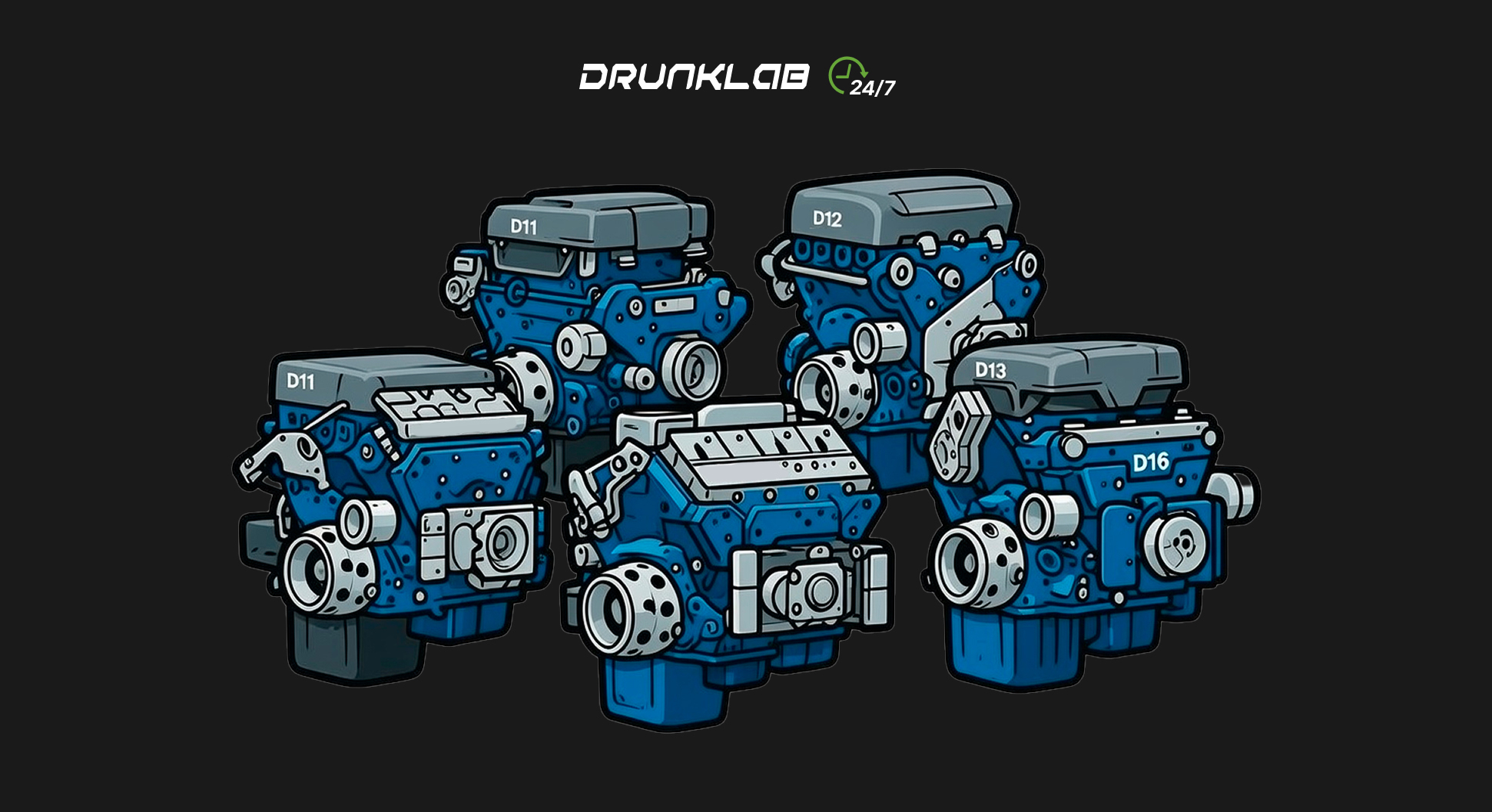
DrunkLab offers support for a variety of Volvo diesel engines as well as multiple ECU generations & emissions compliance.
Supported Engines
- Volvo D11 – EPA10 / EPA13 / EPA17
- Volvo D12 – EGR & early DPF systems
- Volvo D13 – EPA10, EPA13, EPA17
- Volvo D16 – High-power heavy-duty platforms
Supported Vehicle Series
- Volvo VNL / VNX (North America)
- Volvo FH / FM / FMX (Europe & global markets)
- Export Volvo applications
Supported ECU Types
- TRW EMS 2.3 / TRW EMS 2.4 / Bosch EMS 4.x
Volvo D11, D12, D13, and D16 Engines: Applications and Most Common Issues
The Volvo diesel engines D11, D12, D13, and D16 are utilized in various on-road and off-road truck applications, spanning long-haul transport, construction, and heavy-haul truck activities. Each engine platform has its own typical use cases and a set of recurring operational issues that operators commonly face.
- You will normally find most Volvo D11 engines in regional haul trucks, distribution trucks, vocational vehicles, and construction engines. They are widely used in Volvo FM, FMX, and certain VNL configurations where lower weight and good fuel efficiency are required. The most frequent issues with D11 engines are related to EGR and DPF performance, including high soot load warnings, frequent regenerations, and SCR/DEF faults in stop-and-go or heavy-idle operation.
- Legacy fleets and export markets continue to use the Volvo D12 engine, which is an earlier generation engine platform. Older Volvo FH, FM and North American trucks, have these engines praised for their mechanical toughness. Typical problems include EGR valve and cooler failures, intake soot buildup, aging sensors, and limited diagnostic support compared to newer platforms.
- Volvo D13 is the most widespread Volvo engine for long-haul and fleet operations and is commonly used in Volvo VNL, VNX, FH, and FM trucks. While the core engine is reliable, D13 platforms frequently experience emissions-related issues such as DPF regeneration failures, SCR and NOx sensor faults, DEF system errors, and power derate events—especially under heavy load or extended idle conditions.
- Volvo D16 engines are built for high-power applications and heavy hauling, including off-road work like mining, logging, and construction. The D16 engines perform highly demanding tasks and are used in the Volvo FH16, FMX and in specialized VNX trucks. This often reveals weaknesses in the emissions systems.Some of the standard issues are higher EGT (Exhaust Gas Temperature) while regenerating, the turbocharger gets stressed, faults in the SCR system, and decreased aftertreatment components reliability in tough conditions.
Across all platforms, the most common challenges are not related to the mechanical engine itself, but to emissions systems and electronic controls, which are often the primary cause of downtime, derate conditions, and rising operating costs in real-world Volvo truck operation.
Complete Volvo Ecology Systems Delete & Tuning Solutions
DrunkLab provides software-based ecology systems delete, ECU programming, and custom performance tuning for all major Volvo engines. Check out our tuning solutions for the Volvo diesel engines below:
| Engine | DPF Delete | SCR/DEF Delete | EGR Delete | Full Emission System Delete & ECU Remap | Additional Notes / Applications |
| Volvo D11 | ✅ | ✅ | ✅ | Full emission system delete with ECU remap optimized for torque, drivability, and fuel efficiency via Mochester App (M4 App) | Focus on overall performance and efficiency improvements |
| Volvo D12 | ✅ | ✅ | ✅ | Full delete with ECU remap via Mochester App (M4 App) | Legacy engine optimization and fault suppression |
| Volvo D13 | ✅ | ✅ | ✅ | ECU remap for fuel efficiency and torque via Mochester App (M4 App) | Diesel tunes optimized for long-haul and fleet operations |
| Volvo D16 | ✅ | ✅ | ✅ | High-power tuning with safe EGT and boost control via Mochester App (M4 App) | Diesel tuning for heavy haul and mining applications |
Remote Volvo Truck Tuning — Global Coverage
DrunkLab provides worldwide remote tuning, supporting:
- North America
- Europe
- Australia
- And all other countries
We support:
- Volvo FH, FM, VNL, VNX series
- EPA10, EPA13, EPA17 engines
The Mochester App (M4 App) will analyze live ECU data and apply configuration changes remotely with precision.
Volvo Truck Tuning — No Tech Tool Required
The Mochester App (M4 App) represents a major shift in how Volvo owners and fleet operators approach ECU tuning and diagnostics, especially when compared to the traditional Volvo Tech Tool. Unlike Tech Tool, which requires a dealership visit, paid subscriptions, Mochester App lets you connect remotely through any compatible RP1210 diagnostic adapter from anywhere with a stable internet connection. This means no more expensive downtime waiting at a service center — updates, deletes, and calibrations can be done in under 30 minutes right from your home shop or yard. Unlike other software, Mochester’s system is simple yet deep. It provides software for the remediation of performance tuning and emissions loss, and shows the best user experience. While Tech Tool focuses on factory diagnostics and repair, Mochester is engineered for real-world optimization, reliability, and efficiency. For owner-operators and fleets looking to maximize uptime, improve fuel economy, and eliminate emissions-related derate events, Mochester offers a smarter, faster, and more cost-effective solution. In short, where Tech Tool stops at OEM compliance, Mochester begins at real performance and operational freedom.
Using the proprietary Mochester App (M4 App), DrunkLab engineers remotely connect to your truck and perform:
- Software DPF / SCR/ DEF / EGR delete
- Horsepower uprate and torque optimization
- ECU reconfiguration and stock programming
- Emissions derate and fault suppression
What You Need
- A Volvo truck
- Laptop/PC/VM with Windows Vista, 7, 8, 10, 11
- Communication adapter: 88890020, Voсom or ANY RP1210C (Nexiq USB-Link, Noregon DLA , DPA5, Inline, etc).
- Stable Internet connection
Average tuning time: under 30 minutes per vehicle.
Advanced Volvo ECU Tuning & Diagnostic Services
For the highest accuracy and dependability, we utilize our custom developed tuning and diagnostic software, the Mochester App (M4 App) with free fault code reading.
DrunkLab will always supply high quality tuning solutions wherever you may be located. No workshop visit required.
What Is a DPF Delete and What Does It Do?
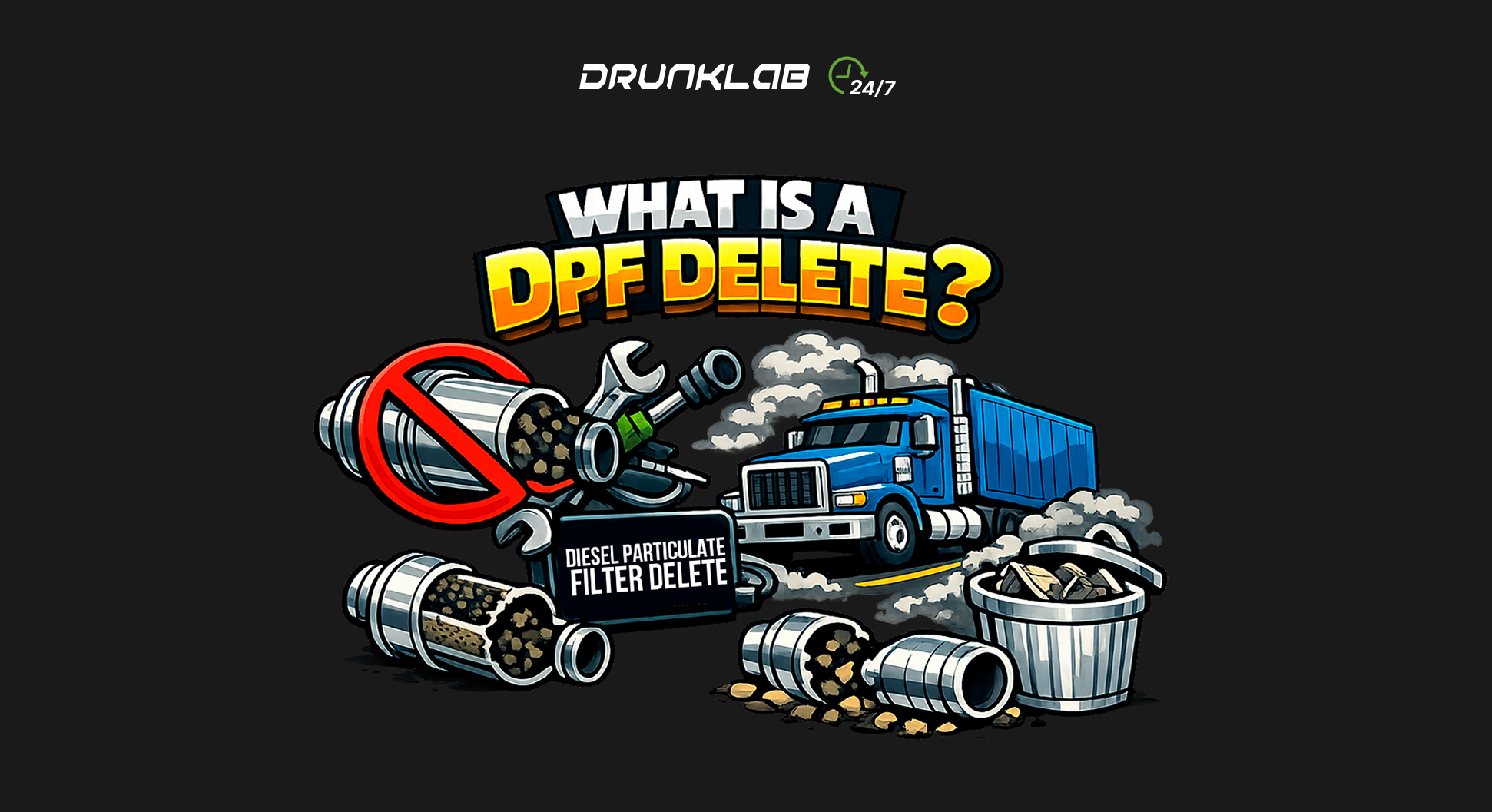
A diesel particulate filter (DPF) delete is a professional engine control unit (ECU) software modification that turns off the DPF logic contained in the ECM. From the manufacturer, the DPF system is made to trap soot and periodically burn it off via forced regeneration. In real-world Volvo truck operation, especially under heavy load, long idle time, or stop-and-go driving, this process often becomes inefficient and problematic.
After a DPF delete, the ECU will be adjusted so that it doesn't monitor, manage, or try to regenerate the particulate filter. This effectively removes:
- Forced and parked regeneration cycles
- High soot load and differential pressure errors
- Emissions-related fault codes and warnings
When we don't ask for more regeneration, the engine operates more predictably, more stably, and with no interruptions due to emissions.
Real-World Benefits
Increased horsepower and torque
The Volvo D11, D13, and D16 engines, when fully deleting emissions systems and remapping ECUs, usually gain significant power and torque. This increase can be up to 30 % in addition to low-end pulling power which varies from one tune to another. This indicates more robust acceleration, superior capacity to climb hills, and greater confidence when performing under heavy loads or when overtaking on long-distance routes.
Improved MPG and fuel stability
Eliminating forced regenerations, DEF consumption, and exhaust restrictions allows the engine to operate more efficiently with cleaner combustion and reduced parasitic losses. Fleet operators and owner-operators generally report more consistent improvements in fuel economy—often 5–15% better MPG—along with more predictable consumption regardless of time spent idling, terrain, or load.
Lower EGT (Exhaust Gas Temperatures)
Without a constant regeneration cycle or EGR recirculation heating the exhaust stream, EGTs will drop considerably during normal operation and especially under load. By allowing for thermal expansion and contraction, the turbocharger, pistons, and thermal efficiency components are kept running cooler and more reliably, even in harsh heavy-haul and hot work conditions.
Elimination of limp mode and derate events
Once the DPF, EGR, and SCR/DEF systems are disabled in the ECU, the truck no longer triggers power reductions or limp mode from soot buildup, NOx sensor faults, low DEF quality, or failed regens. Your Volvo will always be on full power so that you do not have any unexpected roadside slowdowns and you do not miss delivery windows and costly interruptions to your schedule.
Reduced maintenance and downtime
Taking out emissions hardware and associated fault codes eliminates costly DEF refills, sensor replacements, DPF cleanings/rebuilds, and unanticipated shop visits for regen-related problems. The result is dramatically lower long-term operating costs, higher vehicle uptime, and fewer headaches for owner-operators and fleets alike, letting the truck stay productive mile after mile.
When combined with EGR and SCR delete, the engine operates cleaner internally, with more stable combustion and improved long-term reliability.
What Is an EGR Delete and its Benefits
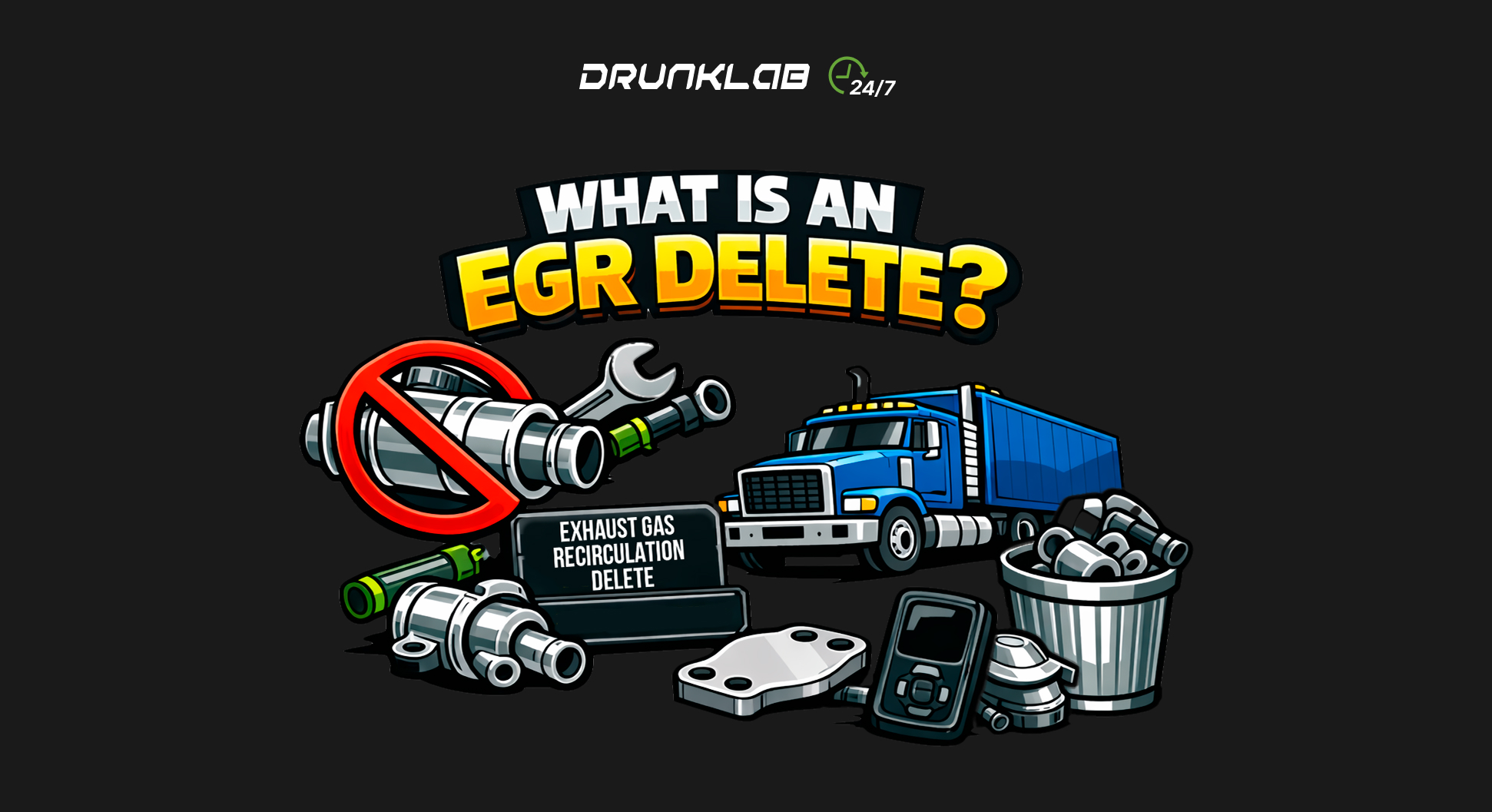
An EGR delete refers to an engine control unit (ECU) software modification that turns off the Exhaust Gas Recirculation (EGR) system on Volvo diesel trucks. While EGR helps meet emissions standards, in real-world operation it increases soot buildup, contaminates the intake, and accelerates component wear.
On Volvo D11, D13, and D16 engines, an EGR delete allows the engine to run on clean intake air only, resulting in more stable combustion and improved efficiency.
Key benefits for Volvo trucks include:
Reduced soot buildup in the intake and EGR components
An EGR delete stops exhaust gas recirculation which, in turn, stops the contamination of the intake manifold and other related components with carbon and soot. This results in less clogging and fewer cleaning jobs throughout the lifetime of the engine.
Improved throttle response and low-RPM torque
With fresh and clean air entering the combustion chamber rather than mixed and diluted exhaust gases, the engine produces a much sharper throttle response and greater low-end torque, allowing the truck to be more responsive during acceleration, as well as during operations with heavy loads and stop-and-go scenarios.
More stable exhaust gas temperatures (EGT)
The elimination of the EGR system prevents the introduction of hot and inert exhaust gases, which facilitates a more consistent and lower peak EGT levels (Exhaust Gas Temperature) during normal operation and under load, safeguarding the turbocharger and other exhaust components from excessive thermal stress.
Lower risk of emissions-related faults and derate
Deactivating the EGR system removes the majority of typical error code of EGR valve malfunctions, EGR cooler leaks, and differential pressure problems, significantly decreasing the possibility of sudden derate events or limp mode which can interrupt hauling schedules and affect productivity.
Improved long-term engine reliability
Cleaner intake air promotes more efficient and complete combustion, minimizing wear on pistons, rings, valves, and turbo components while extending overall engine life, especially in demanding long-haul, heavy-haul, or vocational applications where emissions systems often become the primary failure point.
The EGR delete, when combined with DPF and SCR deletes, removes the stress related to regeneration and guarantees consistent and reliable performance during heavy-duty and off-road applications.
Can You Delete DPF Without Deleting EGR?
In some configurations, DPF delete without EGR delete is technically possible. However, for:
- Long-haul trucks
- Heavy-load applications
- Fleet and vocational use
DrunkLab advises a full diesel emissions delete strategy for best results in efficiency, dependability, and defensiveness toward the engine.
We regularly address questions such as:
- Can you delete DPF and not EGR?
- What happens if you delete DPF without a tuner?
- Does DPF delete void warranty?
All work is performed using verified ECU tuning software, professional ECM programming tools, and tested calibration logic — never generic or unsafe files. Using the Mochester App, our application connects directly to your Volvo’s ECU, analyze live engine data, and apply configuration remotely.
What Is a SCR / DEF Delete and What Does It Do?
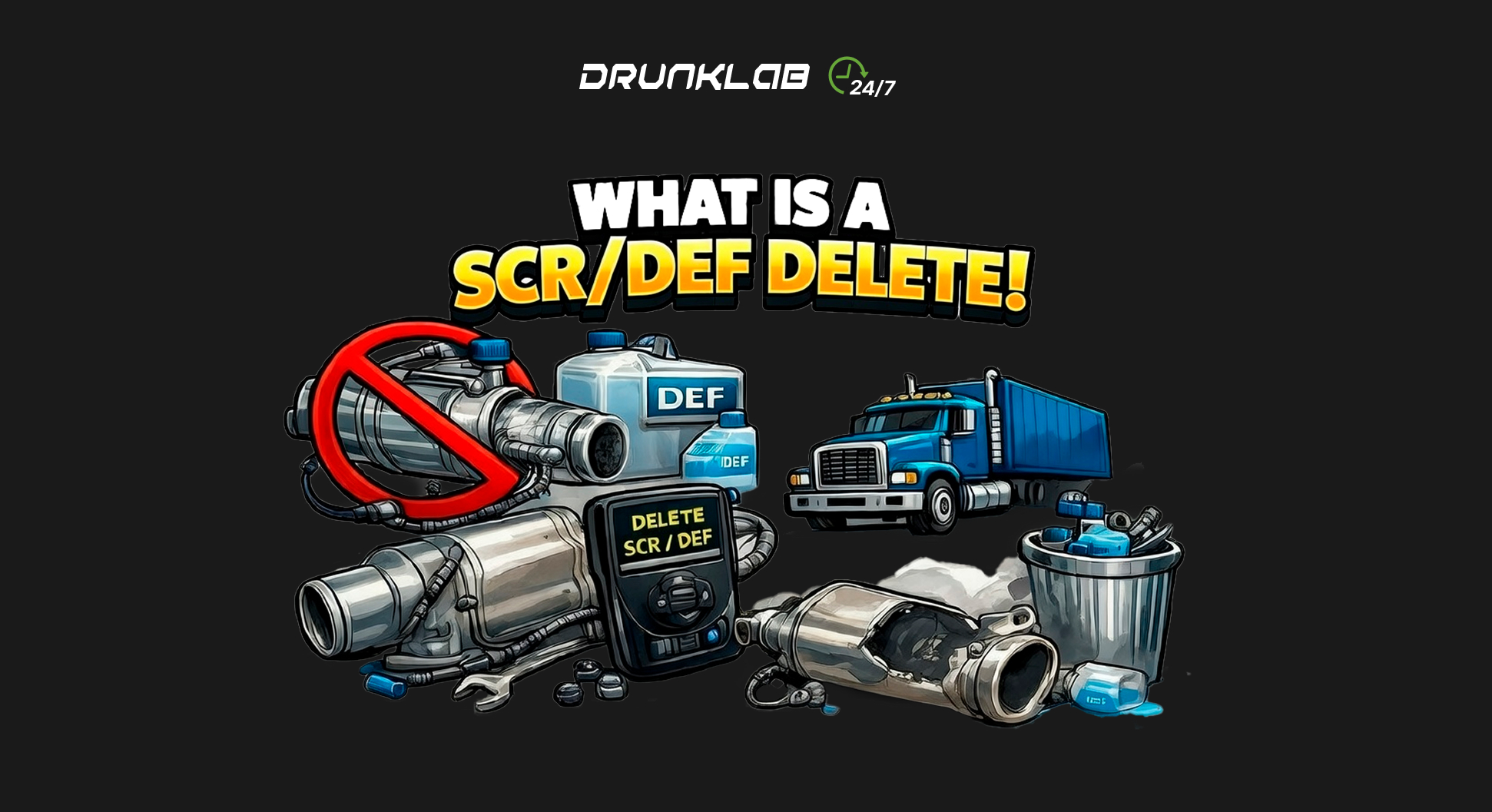
A SCR / DEF delete is an ECU software modification that disables the Selective Catalytic Reduction (SCR) system and DEF (Diesel Exhaust Fluid) dosing logic on Volvo diesel trucks. The SCR system reduces NOx emissions by injecting DEF into the exhaust stream, but in real-world operation it is often a major source of faults, derate events, and operating costs.
The SCR/DEF systems on D11, D13, and D16 engines from volvo are sensitive regarding the accuracy of the sensors, the quality of the fluid, and the operating temperature. If any issues arise, the truck will quickly go into a power derate or limp mode. A SCR/DEF delete changes the ECU so that the engine can operate normally without DEF injection or SCR feedback.
Benefits for Volvo trucks include:
Elimination of DEF/AdBlue consumption and related operating costs
DEF fluid injection refills have been eliminated, resulting in annual savings including fluid purchase, storage, and handling costs. The operational savings are especially impactful in high-mileage fleet DEF fluid expense situations and fluid-related downtime.
Removal of SCR- and NOx-sensor-related fault codes
The SCR/DEF delete disables monitoring and feedback from sensitive NOx sensors and the aftertreatment system, eliminating common fault codes that trigger warnings, service lights, and unnecessary diagnostic trips or part replacements due to sensor drift, contamination, or quality problems.
Prevention of emissions-induced derate and limp mode
What this means for your truck is that unlike other trucks equipped with SCR systems that enforce NOx limits and DEF quality control that cause frustration with power reductions and limp mode during sensor failures, low fluids, and cold starts, you will keep your truck running at full power.
Improved reliability in cold climates and long idle conditions
Cold weather often leads to problems with DEF/AdBlue freezing, crystallization, and dosing, leading to faults and derates, and prolonged idling worsens the SCR system's performance; therefore, by removing the system, the owner is eliminating these problems and providing a better system to help winter and yard time/idle problems.
More consistent engine performance under load
Eliminating DEF injection and SCR restrictions allows for cleaner, more stable combustion without aftertreatment interference, delivering smoother power delivery, better throttle response, and reliable torque output even during demanding heavy-haul or long-haul pulls where emissions systems typically cause fluctuations or limitations.
When combined with DPF and EGR delete, a SCR/DEF delete removes the final emissions dependency from the system, allowing Volvo trucks to operate reliably and predictably in long-haul, off-road, and export applications.
Is DPF/EGR/SCR/DEF Delete Legal?
Common questions include:
- Is SCR/DEF delete legal?
- Is it illegal to delete EGR?
- What happens if you get caught with a DPF delete?
Legality depends on local regulations and vehicle usage. DrunkLab provides services for off-road, export, racing, and controlled-use applications. Always verify applicable laws in your jurisdiction.
Why Choose DrunkLab?
With expert truck tuning, experience is the most important. DrunkLab has more than 15 years of practical experience with Volvo, Mack, Renault, UD Trucks, Paccar, Penta, Cummins, Detroit Diesel, and others. Our engineers understand not just the software, but the mechanical and electronic nuances of each platform, delivering reliable, high-performance results every time.
Innovation drives our work. The proprietary Mochester App allows precise Volvo ECU tuning for DPF, EGR, and SCR deletes, as well as custom horsepower and torque optimization, all while maintaining engine safety. Designed for trucks, buses, construction machines, boats and industrial engines. Mochester supports remote operation, real-time diagnostics, and calibrations tailored to load, terrain, and duty cycle.
With DrunkLab, fleets and owner-operators can always stay on the road thanks to the 24/7 live remote support available around the world. Whether troubleshooting emissions faults, fine-tuning upgrades, or performing remote programming, our engineers deliver expert solutions whenever needed.
When you get tuning services with DrunkLab, you get true engineering expertise, innovative tech, and worldwide support which are all going to give real performance improvements, lower downtime, and fully operational trucks.
DrunkLab delivers professional-grade solutions without compromise.
Performance & Business Benefits
Well-engineered Volvo ECU tuning improves more than just peak performance. When on long-haul and heavy-duty operations, Optimized torque delivery improves feel and response under load, while improved fueling and stability of combustion reduce total fuel consumption and improve drivability.
The engine will run at a consistently cooler temperature without the need for regeneration-related stress and emissions-driven derate events. This will decrease the wear on important components and help the engine last longer.
At the same time, the removal of emissions-related interruptions minimizes downtime, keeping trucks on the road and productive.
Whether you operate a single truck or an entire fleet, DrunkLab helps maximize both performance and Return on Investment (ROI).
Enhance Your Volvo Truck Today
Become part of thousands of happy clients who use our remote tuning options. DrunkLab will help you with Volvo DPF delete and diesel delete tuning as well as sophisticated ECU programming and diagnostics. The Volvo truck solutions optimisation partner you can trust is DrunkLab.
DrunkLab — Professional Volvo Truck Tuning, ECU Programming & Diesel Performance Software.
Got any questions? Our support team is available around the clock, 24/7, to help you out anytime via Whatsapp.