Mack Trucks
Mack Truck Tuning Solutions by DrunkLab
Professional ECU Programming & Diesel Performance Tuning for Mack MP7, MP8 and MP10 Engines
Mack trucks are built with a single focus in mind—hard work with no compromises. Be it construction sites, refuse routes, heavy vocational, or long-haul operations, Mack engines provide the torque, durability, and way, uptime where failure is no option.
Nonetheless, modern Mack emissions systems (DPF, EGR, SCR, DEF) are an extraordinary source and downtime, loss of power, and increased maintenance costs in real-world operations. Under heavy load, idle-heavy duty cycles, and cold weather or off-road conditions, factory emissions systems work against reliability in most situations.
This is the very reason why professional Mack truck tuning and emissions delete solutions have become a necessity, not an option, for fleets focused on uptime.
Common Issues in Real-World Mack Truck Operation
Frequent DPF Regeneration (Active & Parked)
The DPF systems on Mack trucks request system regeneration continuously, even if soot burn-off is not possible with the actual driving scenarios. This problem is most evident in:
- Dump trucks
- Concrete mixers
- Refuse trucks
- Vocational and regional-haul applications
Results include:
Increased fuel consumption
Consistent DPF regenerations and cleans use up diesel that would otherwise be used to carry the load. This increases fuel consumption for every vocational or stop-and-go route.
Excessively high exhaust gas temperatures (EGT)
During active regenerations, EGTs increase to dangerously high levels. This happens under load which damages the exhaust system while the truck is earning revenue.
Turbocharger and aftertreatment stress
Active regens, soot buildup, and backpressure stress turbochargers and aftertreatment systems, converting normally reliable components into parts that fail frequently.
Accelerated failure of exhaust components
In real-world, heavy-duty applications, real-world applications, high-temperature cycles, incomplete combustion, and thermal shock deterioration the exhaust valves, manifolds, pipes, and sensors and shorten their lifespan.
High Soot Load & SCR / DEF System Failures
In combination with extended idling and stop-and-go driving, EGR operations cause excessive soot accumulation. Meanwhile, Mack SCR and DEF systems are highly sensitive to:
Quality and crystallization of DEF/AdBlue
Contaminated or poor-quality DEF will, in a matter of hours, turn to large, rock-like crystals that block lines, clog dosers and injectors, lead to de-rates and faults, and cause expensive downtimes for cold-weather/idle-heavy Mack operations.
Calibration of NOx sensors. NOx sensors drift and become caked in soot, resulting in erroneous measurements of NOx levels, causing the diesel engine control unit to under fuel the SCR and subsequently throw excessive, erroneous codes, resulting in the engine being operated in limp mode and/or experiencing a significant reduction of power, especially during load pulling, with the goal of controlling the engine’s temperature.
Operating temperature thresholds. Mack SCR systems are sensitive to the operating temperature, meaning that a DEF controller must be calibrated to operate within a defined temperature range. During periods of excessive idling, cold starts, or light loads, DEF will not be properly converted, which will cause crystallization and subsequently lead to a series of faults and de-rates of the engine, interrupting and complicating the maintenance scheduling.
Even small deviations can activate fault codes that quickly lead to engine derate or limp mode.
Power Derate & Limp Mode
When emissions thresholds are exceeded, Mack ECUs activate a feature called automatic power reduction. The sudden and repeated nature of these events severely disrupts fleets' job and delivery timelines, as well as their overall productivity.
Sensor & Aftertreatment Module Failures
Modern Mack emissions platforms rely on a complex network of sensors and control modules. Constant exposure to heat, soot, vibration, moisture, and dust leads to:
- Sensor drift and false readings
- Repeated fault codes
- Unnecessary part replacements
- Rising diagnostic and repair costs
- Rising Maintenance Costs & Downtime
Mandatory vehicle regeneration, DEF-related problems, recurring failures of the sensors, and emissions repairs significantly increase operating costs and increase vehicle downtime which in turn affects profitability.
Mack Truck ECU Tuning & Emissions Delete by DrunkLab
DrunkLab specializes in Mack truck ECU tuning, DPF/EGR/SCR/DEF deletions, and remote diesel programming. Our mission is simple and straightforward.
Mack trucks are better off working than parked in the repair shop.
DrunkLab deals with numerous Mack on-road and vocational diesel engine ECU generations and emissions compliance.
If you’re searching for:
- Mack DPF delete
- Mack EGR delete
- Mack SCR / DEF delete
- Remote Mack truck tuning
- Mack emulator solutions
- Mack truck diagnostic software
DrunkLab delivers proven, field-tested results worldwide.
Supported Mack Engines & ECU Platforms
Supported Mack Engines
- Mack MP7 — EPA10 / EPA13 / EPA17
- Mack MP8 — EPA10 / EPA13 / EPA17
- Mack MP10 — EPA10 / EPA13 / EPA17
Supported Mack Truck Models
- Mack Anthem
- Mack Pinnacle
- Mack Granite
- Mack TerraPro
- Mack vocational & off-road platforms
Supported ECU & Aftertreatment Systems
- TRW EMS 2.3 / TRW EMS 2.4
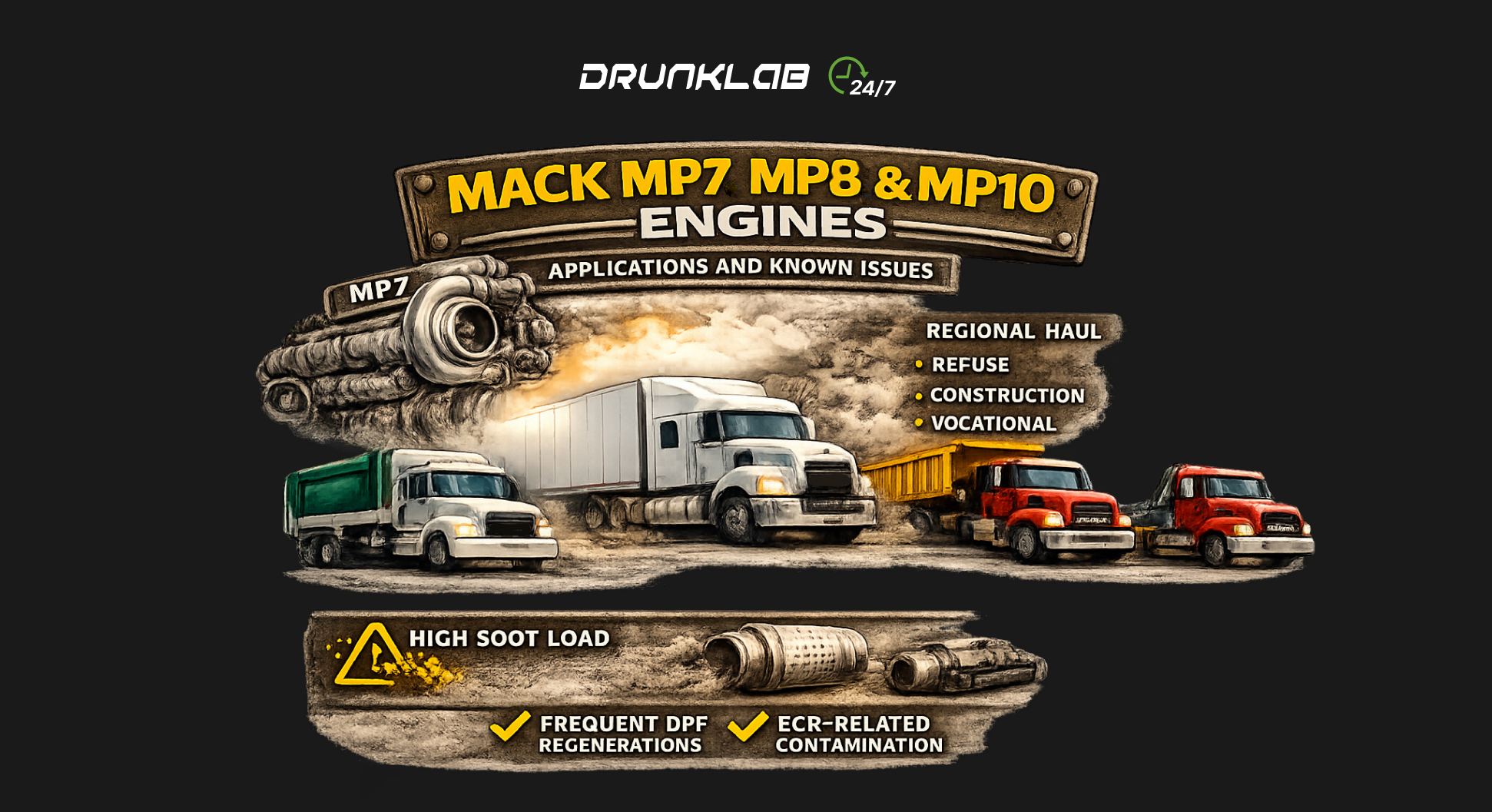
Mack MP7 & MP8 Engines — Applications and Known Issues
Mack MP7
The MP7 can be used in the regional haul, refuse, construction and vocational sectors. While it is mechanically reliable and provides good fuel consumption, it is still susceptible to the following issues:
High soot load warnings - The DPF soot alerts are caused when soot collected in the DPF is a result of incomplete combustion and increased EGR flow, which lead to alerts and a forced regeneration of the system. The system can enter a derate condition if a forced regeneration is not completed, which creates more downtime.
Frequent DPF regeneration cycle - Passive DPF cleaning is an intended function of the DPF system, however, with stop and go driving, the system is unable to perform DPF cleaning passively. The system will demand active (or parked) regeneration approximately every two to three hours. This leads to increased fuel consumption, elevated exhaust gas temperatures, and excessive stress on the entire after-treatment system.
EGR related intake fouling - EGR systems facilitate rapid fouling of the intake system, as exhaust flows hotter than the EGR valve and is fed back into the intake system. This makes the intake manifold, EGR cooler, and turbo become coated in black sludge that is thick and streamlining, which leads to a substantial reduction in engine efficiency and increases the risk of engine failure.
SCR / DEF issues during idling - Operating while idling too often and cold starting the vehicle creates issues with the SCR system because DEF is poorly atomized. This causes crystals and clogs in the doser. This will not only trigger the NOx sensors, but also cause glitches in the SCR system. This will cause the vehicle to go into limp mode, leaving the vehicle stranded in the middle of the shift.
Mack MP8
Designed for high-torque and heavy-duty operation, the MP8 is commonly used in long-haul, heavy haul, and demanding vocational work. Typical problems include:
Regeneration failures under sustained load
With continuous load work, Mack MP8 engines develop issues due to the DPF system under performing as the engine fails to reach high enough temperatures to complete the regen cycle, leading to increased soot build up, increased instances of parked regens, and failures which ultimately reduce engine uptime.
Elevated Exhaust Gas Temperature (EGT) during regeneration
Active regens are initiated while in a load situation which causes an excessive turbo EGT spike which can lead to significant, short term, loss of turbo, after-treatment, and exhaust system cheaper due to cracking/melting caused by the Mack needing to fight through.
NOx sensor and SCR system faults
Cold weather, and cycles of (heavy) idling, are extremely problematic with the Mack MP8 SCR systems where the NOx sensors are prone to drift and dosing faults causing multiple fault codes which can escalate to Power Derate and leave the driver stranded mid job requiring costly sensor replacements.
Power derate during critical work cycles
The emissions issues with Mack trucks cause the engine control unit (ECU) to enter a required power derate and limp mode, exactly when the engine is under the most strain due to the truck having to haul a load up an incline or finish a concrete pour which is obviously frustrating for customers and costly for tow bills since there is no indication to the driver.
Mack MP10
The Mack MP10 is the largest and most powerful engine in the Mack lineup, designed specifically for extreme heavy-haul, oversized transportation, logging, mining, oil field, and other severe vocational applications. The MP10 has been designed with serious tonnage hauling in mind with up to 16+ liters of displacement and enormous torque output. However, It has the following problems:
Frequent DPF Overload Under Extreme Load
Under sustained heavy-haul conditions, the high fuel flow and soot production of the MP10 often exceed the DPF’s passive regeneration capacity, triggering repeated active or parked regens and increasing the risk of restriction-related fault codes.
Excessive EGT During Regeneration Events
Active regeneration cycles on the large-displacement MP10 can drive exhaust gas temperatures to extreme levels, accelerating thermal fatigue of the turbocharger, exhaust manifold, and aftertreatment components.
SCR / DEF Failures Under Heavy Torque Operation
High torque operational NOx output increases the amount of DEF that must be dosed. This often causes the following issues: NOx sensor malfunctions, DEF crystallization, SCR failure, and finally, engine derate events.
EGR System Stress on High-Displacement Platform
The high axial mass flow from the MP10 exhaust places considerable load on the EGR system which results in accelerated soot buildup in the intake, EGR cooler clogging, reduced airflow efficiency, and reliability concerns in the long run.
Across all Mack platforms, the engine itself is rarely the problem. Emissions systems and electronic controls are the leading cause of downtime and lost productivity.
Complete Mack Emissions Delete & Performance Tuning Solutions
Using their own Mochester App (M4 App), DrunkLab offers software-based Mack emissions delete and ECU remapping.
Mack MP7 Delete & Tuning
- Mack MP7 DPF delete
- Mack MP7 SCR / DEF delete
- Mack MP7 EGR delete
Full emissions delete with ECU remap optimized for torque, drivability, and fuel efficiency
Mack MP8 Delete & Performance Tuning
- Mack MP8 DPF delete
- Mack MP8 SCR / DEF delete
- Mack MP8 EGR delete
High-torque diesel tuning with safe EGT and boost control
Mack MP10 Delete & Performance Tuning
- Mack MP10 DPF delete
- Mack MP10 SCR / DEF delete
- Mack MP10 EGR delete
Extreme heavy-haul torque optimization & EGT control
Engine & Service Overview
| Engine | DPF Delete | SCR/DEF Delete | EGR Delete | Notes |
| MP7 | ✅ | ✅ | ✅ | Full emissions delete & ECU remap |
| MP8 | ✅ | ✅ | ✅ | High-torque tuning for heavy-duty use |
| MP10 | ✅ | ✅ | ✅ | Extreme heavy-haul torque optimization & EGT control |
Remote Mack Truck Tuning — Worldwide Coverage
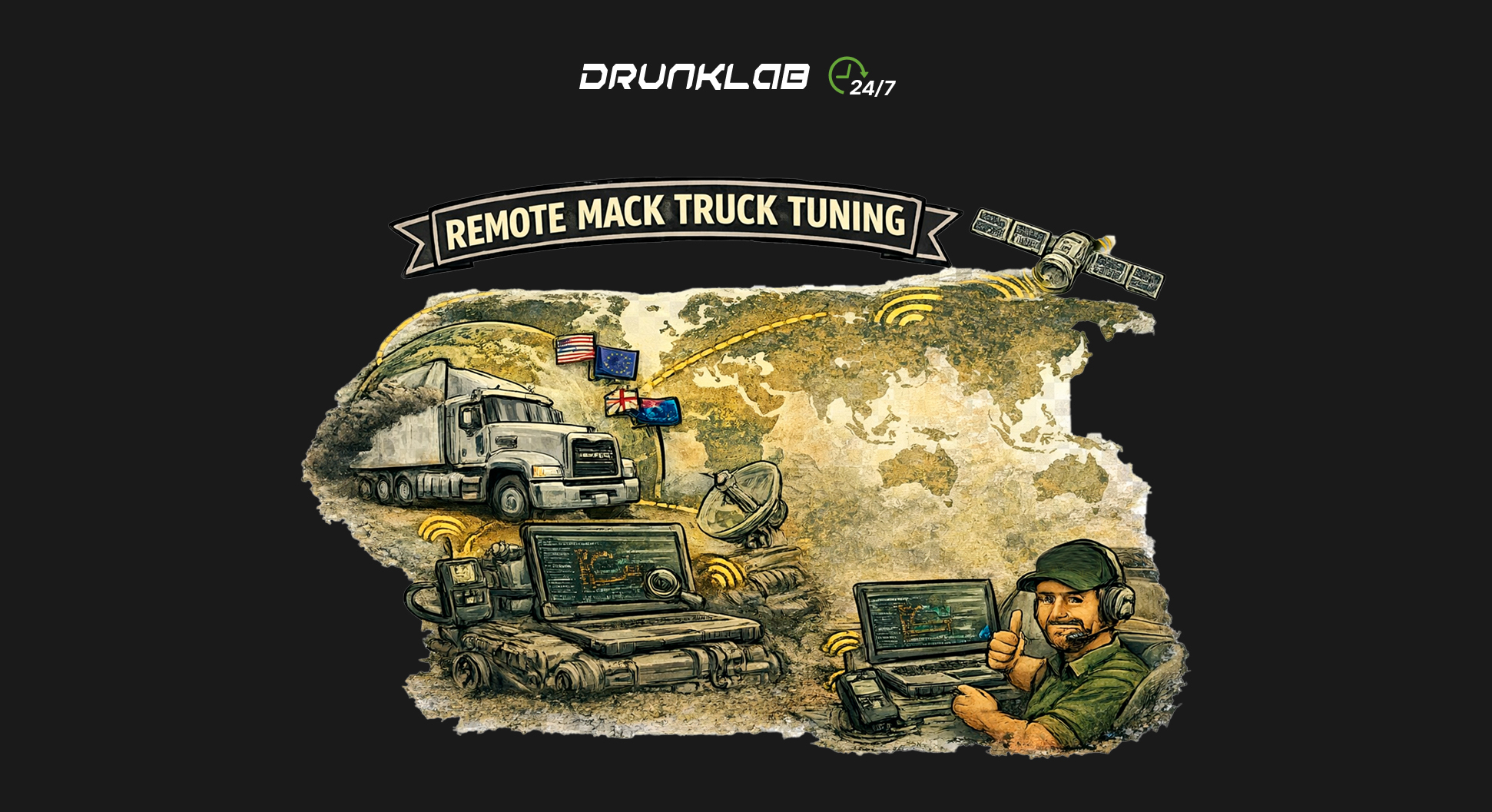
DrunkLab provides global remote Mack truck tuning, supporting:
- North America
- Europe
- Australia
- Export markets worldwide
Mack Truck Tuning Without Dealership Software
The Mochester App (M4 App) eliminates the need for dealership-only tools, subscriptions, and downtime.
With Mochester App, you get:
- Remote ECU access
- Free Fault Codes Reading
- DPF / EGR / SCR / DEF delete
- Stock and performance programming
All performed remotely — often in under 30 minutes per truck.
While factory tools end at compliance, Mochester App (M4 App) starts at real-world reliability and uptime.
What You Need
- A Mack truck
- Any Laptop/PC/VM with Windows Vista, 7, 8, 10, 11
- Communication adapter: 88890020, Voсom or ANY RP1210C (Nexiq USB-Link, Noregon DLA , DPA5, Inline, etc).
- Stable internet connection
What Is a DPF Delete on a Mack Truck?
A Mack DPF delete is an ECU software modification that turns off the diesel particulate filter logic within the ECM so that the ECM will no longer make regeneration requests or cause emissions-related engine derates.
Real-World Benefits
Increased horsepower and torque
Once an emissions delete and ecu remap are performed, in most cases, additional MP7 and MP8 engine resources become available. These are resource emissions control systems. Customers report gains in horsepower as well as torque at all RPM ranges. As a result, this means all ranges, especially at low-end RPM’s acceleration is noticeably improved. In vocational and haul applications, heavy loads will feel lighter and acceleration will be more responsive. This is not just an increase in dyno numbers. This is an increase in actual pulling power which will have a positive effect on the productivity of the fleet. These trucks will be able to work instead of be in a constant state of struggle.
Improved MPG and fuel stability
Eliminating constant DPF regens, DEF dosing, and EGR soot recirculation cuts out the extra fuel those systems burn unnecessarily. Fleets report more consistent miles per gallon with less fluctuation, since the engine runs cleaner internally and doesn't waste diesel on forced cleanings or limp-mode events. The result is steadier fuel costs and better predictability on long routes or stop-and-go jobs.
Lower exhaust gas temperatures (EGT)
The removal of constant DPF regens, DEF dosing, and EGR soot recirculation eliminates the unecessary fuel burning of those systems. Fleets have resported a more consistent MPG as a result. The engine will not be dirty and will not waste fuel on forced cleaning or in limp mode. The expenses will be noticeably more stable and predictable and on long haul jobs and in a stop and go scenarios.
Elimination of limp mode and derate
It is now possible to eliminate emissions related derates since these components have become a significant part of the engine control unit. No one wants to see their truck go from derate to full power. The def ecu means the truck will def throttle, def derate, and end def cycle, all emissions related to.
Reduced maintenance and downtime
Removal of emissions hardware will remove the most common causes of the fleets shop time - broken sensors, DPF clogging, DEF line crystallization, and repeated regen cycles. Time spent chasing key false error codes will be reduced, and less will be spent on aftertreatment part replacements due to the real duty cycles. The truck will be more productive, improving profit and reliability.
With the removal of the EGR and SCR systems, the engine will also be more reliable and will internally remain cleaner.
What Is an EGR Delete on Mack Engines?
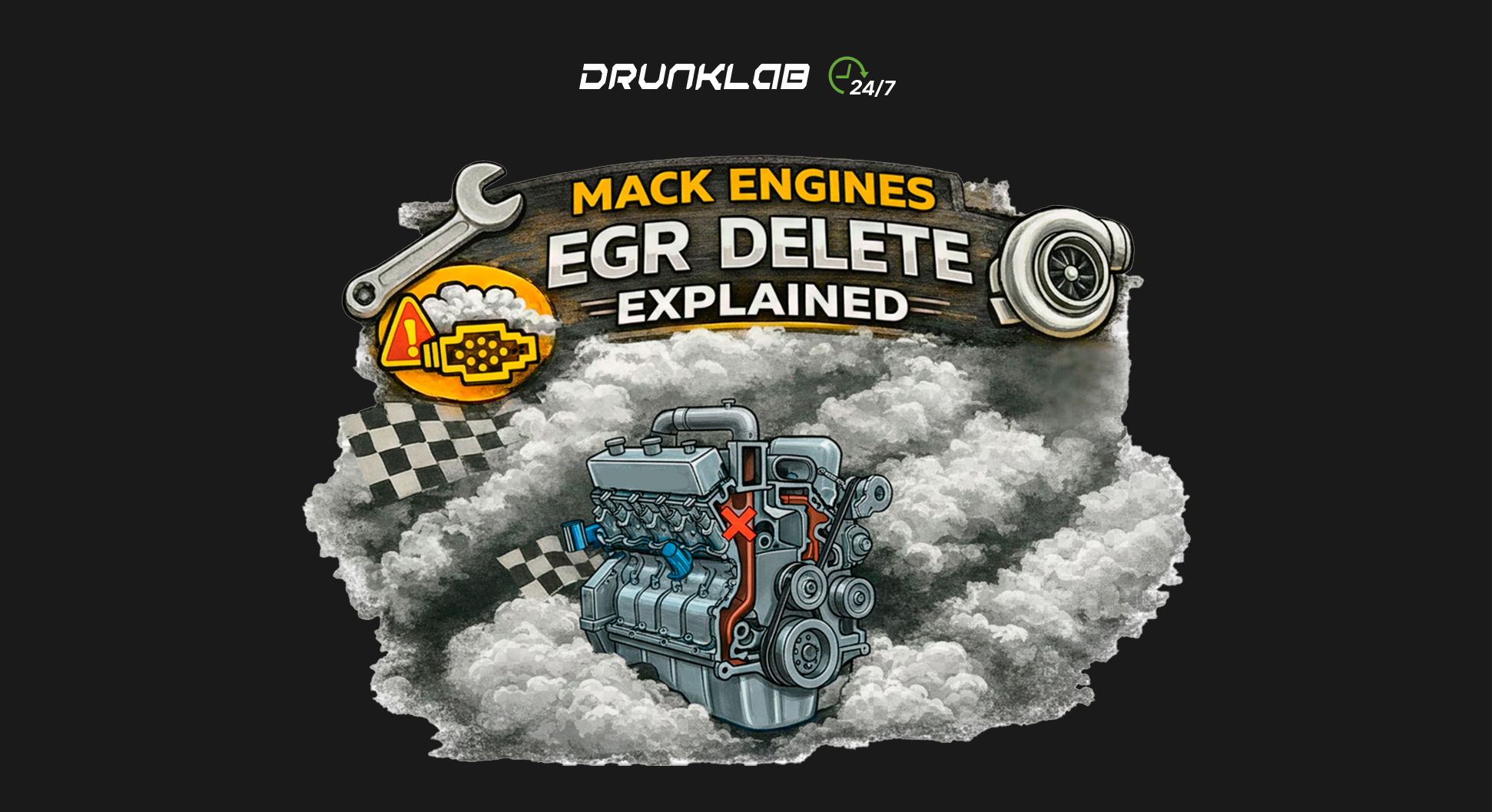
An EGR delete disables exhaust gas recirculation logic, allowing the engine to operate on clean intake air only.
Reduced soot buildup
Turning off the EGR system means recirculated exhaust gases will not be sent to the intake. Therefore, less soot and carbon will be recirculated and deposited into the intake manifold, EGR cooler, and turbocharger. Thus, the engine will ‘breathe’ a pure air charge and over the long term, this will create less black sludge build-up which will improve engine performance. The fleets will notice cleaner engines and less frequent and less extensive cleaning and parts replacement intervals.
Improved throttle response
When EGR is removed, the passive intake charge is replaced with active gases that encourage combustion to be more vigorous. This leads to less lag in engine response and increases the ability of the engine to quickly change RPMs in response to the driver depressing the throttle. This results in a stronger engine pull during low RPMs, and a more responsive engine when heavy loads are being towed. The tuned trucks are noticeably different to operate and drive compared to trucks that have not been tuned.
Stable combustion and EGT
Without EGR, combustion is more stable and easier to predict since the ratio for the combustion mixture will be the same during all operating conditions, thus leading to more stable combustion and less drastic variable exhaust gas temperatures. There is no long going to be large fluctuations in temperatures caused by the engine's components going to their performance limits. This also protects the valves, pistons, and turbos and helps the engine operate more efficiently and cooler.
Lower risk of emissions-related faults
Without the EGR function, Mack trucks will no longer have the EGR valve binding, EGR cooler leaks, pressure differentials, and subsequent derates, which are the largest source of faults in their duty cycles. There will no longer be sensors that are interrupted and circuits which lead to the engine light being triggered and the truck going into limp mode, as well as roadside interventions. Emission faults lesses the amount of time in the shope for repairs.
Improved long-term engine reliability
Inoperability due to emissions is typically the first time to have to empty the cabin from a truck. Many have emissions and legally safe for a long time. Many company owners have seen their trucks operative 300,000 miles more post emissions delete, despite minimal repairs. This is the longevity that allows trucks to remain productive and actively earning money for the company. Because the more EGR delete safe the engine is, the limits of the factory components in the engine are less likely to be reached.
What Is a SCR / DEF Delete on Mack Trucks?
An SCR/DEF delete will turn off DEF dosing and SCR feedback logic within the ECU.
No DEF/AdBlue consumption
By eliminating the SCR system, your Mack truck no longer needs DEF fluid, meaning no more frequent refills, no more concerns about poor-quality AdBlue crystallization, and no more DEF-related codes and derates. Fleet operators for heavy vocational or idle-heavy cycles will see the benefits of their investment immediately by eliminating operational costs and avoiding interruptions due to empty DEF tanks or frozen DEF lines in the winter. This deletes one of the largest costs for operating emissions-compliant Mack trucks.
Elimination of SCR and NOx sensor faults
Once the SCR/DEF logic has been removed from the ECU, the adverse effects from the NOx sensor drifts, faulty doser, and countless SCR faults will no longer be an issue, and you will no longer have to deal with nonsensical limp mode activations. This will also reduce the number of codes logged in the ECU that would otherwise be causation for sensor swaps or expensive trips to the dealership. This will also reduce the number of codes logged in the ECU that would otherwise be the causation for sensor swaps or expensive trips to the dealership. The result is a significant scavenging of the engine's Operation Logs, a reduction in the number of headaches associated with a malfunction, and a system that actually works reliably in the Duty Cycle conditions where the factory configuration is inadequate.
No emissions-induced derate
Your Mack no longer has emissions limits that will choke your power outputs. No more surprise derates. No more limp mode events that restrict your productivity under load or when you're on a time constrained job. The ECU will no longer trigger derate penalties because of excessive soot, failed regens, or DEF/SCR issues. The same goes for your MP7 or MP8. It will provide the same torque and performance deflections when the job requires it. Operators driven by uptime demand trucks that stay in the fight and don't need to be crawled or sidelined for resets.
Improved reliability in cold climates and idle-heavy operation
Previous SCR/DEF systems would suffer from the issues of crystallization, dosing failures, and derate-causing regens from the combination of cold starts, extended idling, and freeze- prone environments. With a full delete, we take a step away from all of that. Because the engines will be operating without the components that are in the way of the duty cycle of the engine, we provide you with a higher likelihood of avoiding heat-induced failures and increased combustion stability. This will help to improve all of the conditions that we are known for at Mack Trucks. Our vocational fleets in northern regions or refuse/waste applications provide an extreme decrease in the frequency of breakdowns and an extreme increase in the duration of time between required servicing.
Is Mack DPF / EGR / SCR / DEF Delete Legal?
Legality depends on local regulations and vehicle use.
DrunkLab services off-road, export, racing, and controlled-use applications only. Always check your local laws.
Why Choose DrunkLab for Mack Truck Tuning?
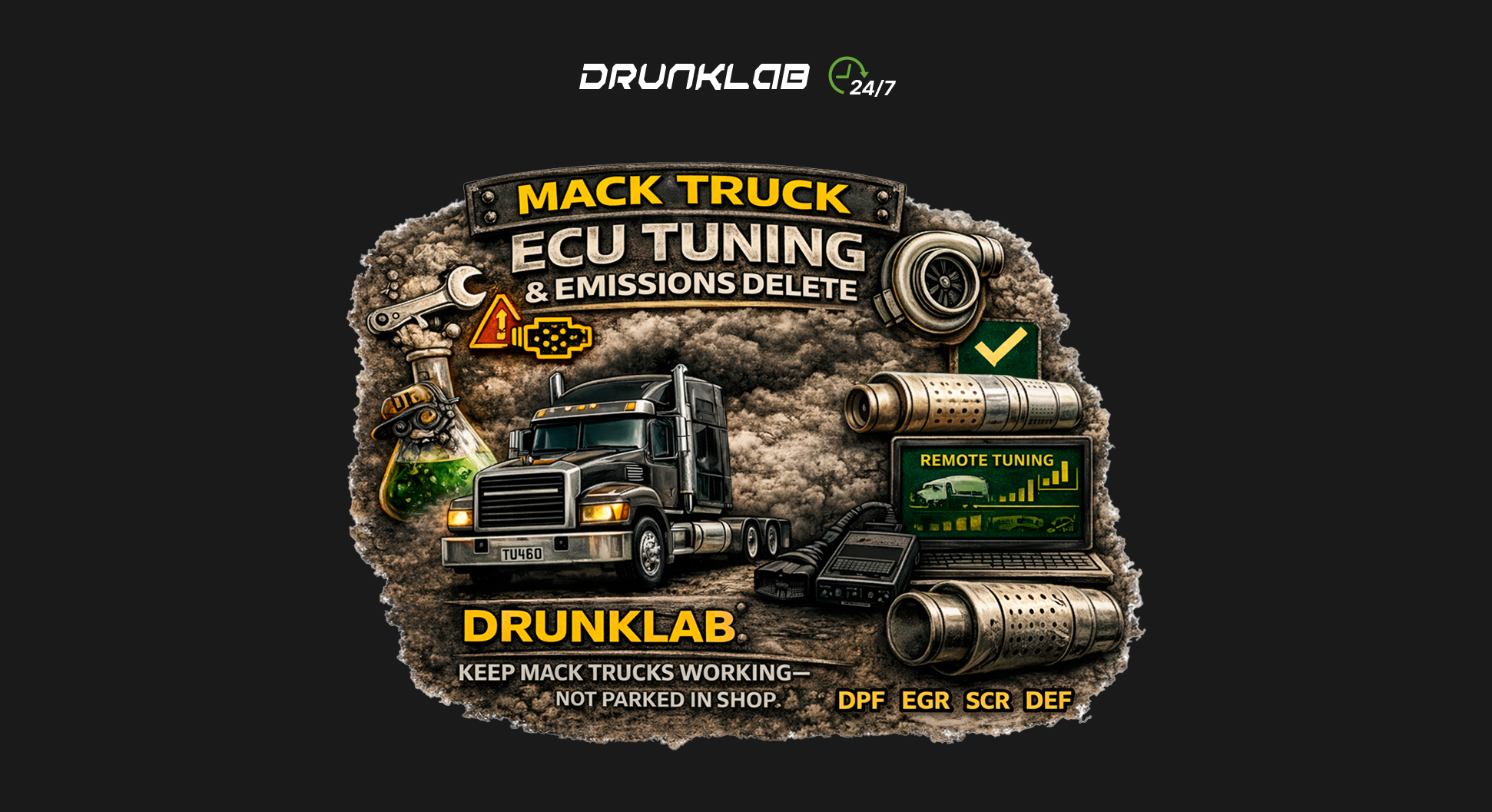
DrunkLab will give you tuning based on over 15 years of real engineering experience, not cookie cutter tuning files.
We offer:
- Professional Mack truck ECU tuning
- Verified emissions delete solutions
- Torque and power optimization
- Remote diagnostics and programming
- 24/7 worldwide technical support
Diesel Truck Tuning Near Me?
Stop searching.
DrunkLab offers remote diesel tuning for Mack Trucks globally, regardless of your location. With transparent terms, proven results, and professional support, we have thousands of happy customers.
DrunkLab — Professional Mack Truck Tuning, ECU Programming & Diesel Performance Software. Got questions? Our support team is available 24/7 via WhatsApp.